




“What’s this line?” a man asked, gesturing at about fifty people snaking along the hallway of the Convention Center in downtown Washington, D.C. Another man, dressed in a sloganed sweatshirt–HOT DADS FOR ZOHRAN–answered: “This is for Israel-Palestine.”
It was Saturday afternoon, four days after the midterm elections returned Democrats to power and affirmed the worldview of those spending their weekend at Crooked Con, the second annual gathering hosted by Crooked Media, the podcast network founded by former Obama aides Jon Favreau, Tommy Vietor and Jon Lovett in 2017.
Crooked’s programming has been an unofficial venue for the mainstream center-left to sort itself out since the start of the Trump era. It’s where Graham Platner tried to explain away his Nazi tattoo (he was drunk, he said), where architects of Kamala Harris’s 2024 campaign tried to explain away her defeat, and where Hillary Clinton celebrated Trump’s second arraignment.
“I don’t know if it’s a political movement or a media company,” Favreau once said. Whatever you call it, it’s popular. Styled after partisan gatherings like Netroots and CPAC, tickets to Crooked Con, sponsored by political and media organizations, cost $199 to $249.
The room at the head of the line was dubbed “The Echo Chamber.” Inside, a debate was underway. Vietor moderated a panel on the Middle East featuring Joel Rubin, an Obama-era assistant secretary of state, and Tariq Habash, a senior Biden administration education adviser who resigned in protest of the administration’s support for Israel as its military response intensified after the October 7, 2023, Hamas attacks.
The debate was a battle for applause. By the end, only about ten attendees remained in Rubin’s corner, who stated he opposed restrictions on weapons sales to Israel.
It was a glimpse of the same divisions that have fractured Democrats throughout the war.
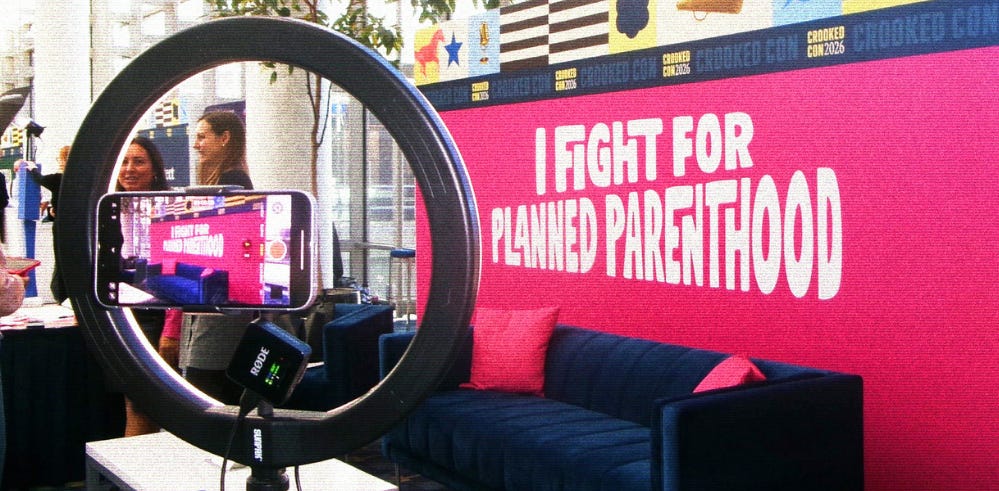
Throughout the building, I spotted pink hair, blue tote bags, tiny microphones and ring lights. Upstairs, Democratic influencers recorded content while party leaders rehearsed their talking points. In Crooked’s spin room, lawmakers lined up against branded backdrops, bracing for questions and, no doubt, hoping to be asked about 2028. All indications that business was booming for the pundits and personalities whose personal brands have become intertwined with the left-wing movement.
By appearances, America had entered Woke 3: the latest incarnation of the anti-Trump movement, which this time had proved electorally popular. But newfound popularity brings responsibilities. More than two years after the defeat that returned Trump to power, Democrats still have no clear leader or consensus on what comes next.
The party had come to Washington to celebrate the success that will manifest here with the new Congress. It had also come to argue: What would Democrats do with their newfound power?
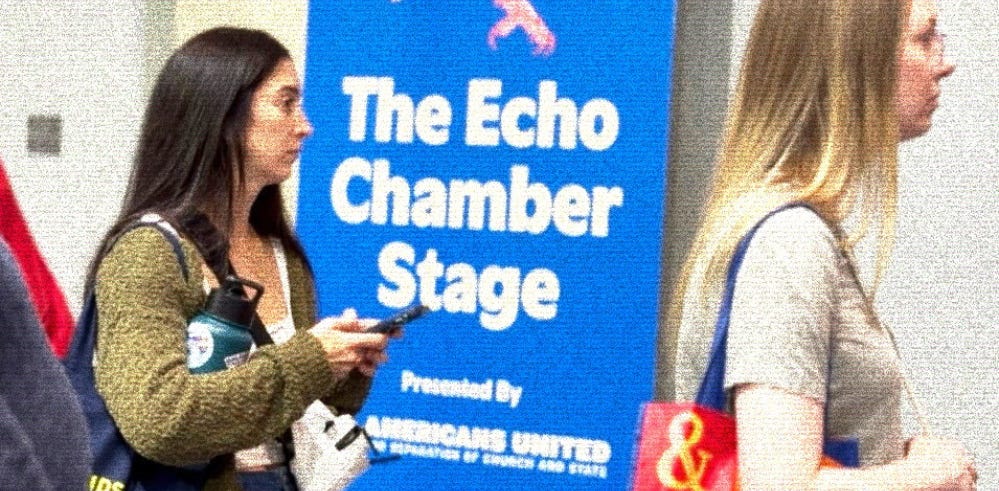
I was still waiting to enter The Echo Chamber when I struck up a conversation with the young man in front of me. We agreed it was the longest line of the conference, perhaps because of the subject matter.
His name was Owen Underwood. The 24 year-old described Crooked Con as a “strange mix” of celebration and anxious calibration about “what to do next.”
The blue wave had arrived, but no one seemed certain the party could swim.
When we finally entered The Echo Chamber, I leaned against the back wall to observe the crowd. Underwood headed for his seat, leaving me with a business card featuring an unclothed, memeified Vice President JD Vance.
Afterward, I caught up with Habash. “I don’t want to paint a rosy picture that doesn’t exist,” he told me. “I do think there need to be lines on where the big tent ends.”
Downstairs, “The Big Tent” room was proving not quite big enough. In the hallway, people held their phones overhead to catch a glimpse of Favreau, who arrived to roaring applause for a conversation with Sarah McBride, a member of the House from Delaware, and Melat Kiros, who just won her race for that chamber in Colorado, and Chris Van Hollen, the senior senator from Maryland.
As Van Hollen moved between panels, insidery buzz followed: Would he challenge Chuck Schumer for leadership? One Democratic strategist suggested it was possible, not due to special knowledge of Van Hollen’s plans, but due to common knowledge of Schumer’s vulnerabilities.
“Once the pressure is up, how many people will want to stand with Schumer?” the strategist asked. Another Democratic operative later complained that Schumer was “on a press tour” as usual. “Chuck’s a pain,” this person added, (It remained a subtle reflection of Schumer’s weight in Washington, haters notwithstanding, that neither Democrat wished for their criticisms to be quoted on the record.)
Maryland Governor Wes Moore, meanwhile, was happily taking selfies with conference-goers. He had just signed a trading card featuring himself, a novelty I joked might someday be worth something. His aide laughed.
Moore laughed, too, when asked whether he planned to run for president. He eventually offered the kind of lengthy non answer customary of politicians who may be considering a presidential bid.
He had no similar trouble on the topic of Tuesday’s results. Voters had sent a clear message, he said: “Do something.” Midterms are the so-called report card for the sitting president and the party that executes his platform. Voters hadn’t arrived to the polls for intraparty fighting over what philosophies should prevail in the next presidential election, but to issue a verdict about those empowered by the prior one.
One Crooked Con attendee who said his name was Nelson Foster put it more simply: “We’re in an unstable place.”
Accountability was the word of the day. Yet Trump, who returned to office after two impeachments and dozens of felony counts, came up less often than members of his cabinet and broader political network. Among Democrats, speculation was already turning toward the possibility of investigations and checks-and-balances catharsis.
But one word elected Democrats seemed hesitant to utter was impeachment. Carlos Calzadilla-Palacio, founder of Disrupt, the left’s answer to Turning Point USA, had no such hesitation.
“If we’re going to impeach, we need to go into every single detail of Trump’s family, his corruption, his buddies, all of them,” he said. “We have to indict his entire administration.”
That is precisely the charge Republicans have been making for years: that Democrats want to do to Trump what Trump promised to do to them.
Calzadilla-Palacio rejects the comparison.
“It’s not retribution,” he said.
“It’s justice.”
Trump’s fate, along with that of other administration officials, may soon rest in the hands of Robert Garcia, the representative from California vying to chair the powerful House Oversight Committee.
At the after-party at City Tap House, Garcia’s hands were full–with drinks he offered to fetch for staffers and reporters.
It was an open bar. But who could blame him for being a little overzealous?
The night after the convention, I called Morris Katz, the 27-year-old Zohran Mamdani adviser and strategist to progressive candidates across the electoral map. He had suffered a less-than-ideal start to this cycle when he had the bright idea to pluck an oyster farmer from obscurity and run him for the Senate (the Platner campaign, hobbled fast by the revelation about the Nazi embellishment on his skin, and was suspended over sexual misconduct allegations), but he emerged on election night with enough wins in high-profile races (Gina Hinojosa in Texas, Keisha Lance Bottoms in Georgia, and Abdul El-Sayed in Michigan) to earn him veritable celebrity status among people who consider political strategists celebrities.
He sounded tired. Such is the cost of “living through a realignment.” Still, he said, he was “proud to be a fucking Democrat.”

I asked who he considered the party’s leader. He said Rahm Emanuel, then laughed.
If Rahm was a joke, then who did Katz take seriously? Alexandria Ocasio-Cortez, he said. If she runs, “I think she’s the frontrunner for the nomination.” He added: “The two women we’ve nominated have been uniquely bad presidential candidates. I would not over-index towards two of the least popular politicians in recent American history.”
Helpfully, or maybe not, Crooked Con had conducted a straw poll on that very subject. Jon Ossoff came in first, with thirty-eight percent. Ocasio-Cortez came in second, with sixteen.
And although the party has the power, what it lacks is the right person to hand it to.
“The blue wave had arrived, but no one seemed certain the party could swim.” 🔥